
A game designed by Yaël Nazé (FNRS/ULiège)
Welcome to space!
You can now develop space activities… but available orbits are in limited number, and you'll have to manage debris, collisions, and other players!
A game designed by Yaël Nazé (FNRS/ULiège)
You can now develop space activities… but available orbits are in limited number, and you'll have to manage debris, collisions, and other players!
This game requires two to four teams. Each team chooses a color and takes the 31 tokens of that color, placing them in a bag, well shuffled. The game master randomly (and secretly) places one "K" (Kessler) token into one of the bags.
Each team randomly draws 8 tokens – throughout the game, a team must have 8 tokens in front of it at any one time; if it has fewer, it must draw tokens from the bag at the beginning of each turn, until the supply is exhausted.
Thirty of these tokens are satellites. There are 5 types of satellites, each with 6 tokens:
 ): a satellite that observes the Earth or the universe to improve scientific knowledge.
 ): a satellite that offers a commercial service (communication, imagery, etc.) for financial gain.
  ): a satellite that assists in military activities (guidance, secure communications, espionage, etc.).
 ): a satellite capable of performing two functions, one military and the other commercial (e.g., general and secure communications, general and reconnaissance imaging, etc.).
 ): this in-orbit servicing system allows a satellite that has become unusable to be restored to working order (through repair, refueling, etc.).
 The two additional tokens represent events: major collision( ), Kessler(
 ).
).
Place the orbital board in the center.
The goal of the game is to last ten rounds without having a completely occupied board. Each satellite then counts as one point.
In each round: each team draws tokens to have 8 of them, then takes turns deciding to place zero to 8 satellite on the board. Scientific, commercial, military, or dual-use satellites are placed in the available spaces on the board. A repair satellite is placed on a dead satellite, allowing it to become active again. Be careful, the game ends (and everyone loses) when there are no more free spaces on the board.
One of the teams (color chosen by a die roll) starts playing after two turns. [This reflects the technological lag of some countries that gained access to space later...]
Two tokens must be used immediately if drawn:
): When a large collision occurs, the affected team loses a satellite and creates six pieces of debris that must be placed on the board in free spaces. The affected team cannot play any other tokens during this turn.): A massive collision has produced so much debris that the entire orbital area becomes unusable. The game ends, all teams lose, and the board must be cleared.When all teams have played, the game master removes two dead satellites
* To choose which satellite is disabled, roll the die a second time to select the color (and therefore the team) involved:
 )on a satellite of the chosen color (and of the specified type if there is a restriction).
# Place a debris token ( ) on an empty space on the board.
** For the takeover, roll the die once to identify the team that loses a satellite and a second time to identify the team that replaces it.
Goal: 10 cycles without filling the board!
Place a "K" token in one of the token bags.
Each team takes a bag and draws tokens to always maintain a total of 8 in front of them. One team starts to play two rounds after the others*.
Tokens to play immediately:
: Everyone loses!
: one satellite lost* (place on it), place 6 pieces of debris on the board. Otherwise, each team places 0 to 8 tokens on the board.
Before proceeding to the next round, clear the board (remove two malfunctioning satellites or debris) and then roll the dice:
This is where you will find all the instructions and files to download to build your own versions of the game.
This is an easy-to-print paper version requiring only a desktop printer and colored paper.
Simply print each page following the instructions.
Download the PDF: Orbit-Jam-papier.pdf
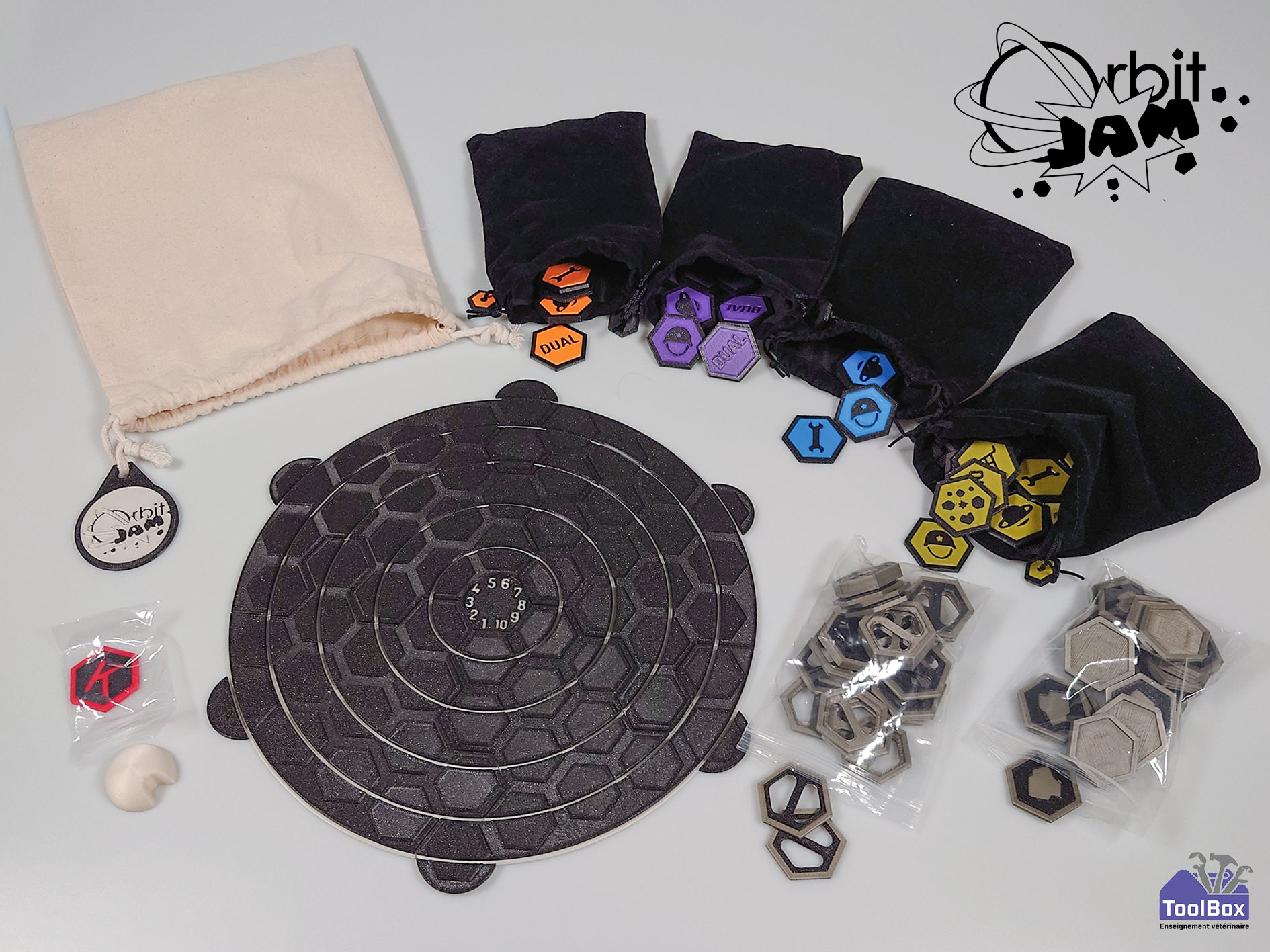
Here are some recommendations for printing the different parts correctly:
The game board and all the tiles can be printed in PLA.
Please note that most of the pieces are two-tone. The procedure will therefore differ depending on whether you have a single-filament or poly-filament printer:
Supports are essential for the proper interlocking of the tiles.
The .3mf files are initially designed for printing on the Prusa XL, which has a large build plate and multiple print heads. Use them as a guide to generate G-code files adapted for your printer.
The containers are standard sizes and readily available: